The Novel
Sweet Sorrow is the second Hubert and Banfield novel, but it was written to stand as a story in its own right.
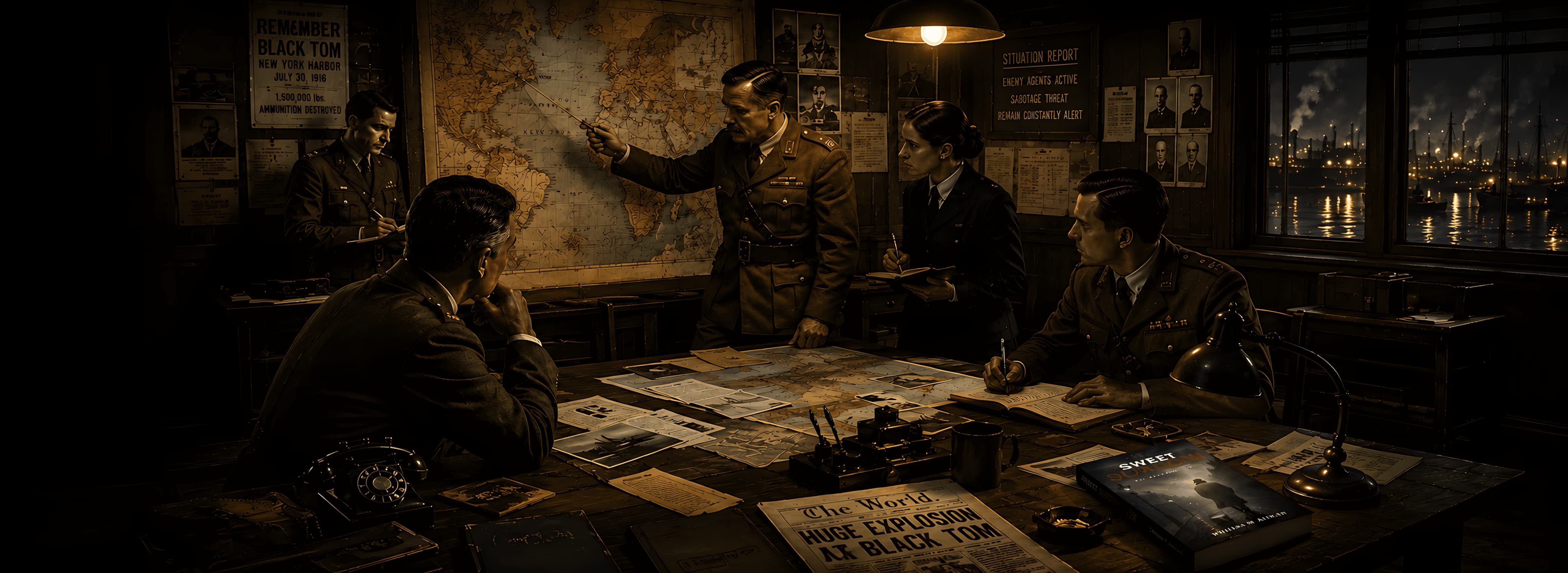
It is a novel about espionage before espionage had acquired its familiar rules. America is still neutral. Britain and Germany are already at war. Diplomats, policemen, shipping companies, businessmen, private detectives and intelligence officers operate in a world in which the boundaries between diplomacy, espionage and sabotage are becoming increasingly difficult to see.
Into that world come Hubert and Anne Banfield.
What follows is not a conventional spy story of secret gadgets and polished professional agents. It is a story about people trying to discover what their opponents are doing at a time when nobody — including the intelligence services themselves — yet possesses the machinery we now associate with modern intelligence work.
Hubert and Anne
At the centre of the novel are Hubert and Anne Banfield. Their relationship was one of the things I most wanted to develop after Blackest of Lies.
Hubert is intelligent, observant and capable, but he is not James Bond transported backwards into 1916. Nor is Anne there simply to accompany him. They bring different abilities, different instincts and, occasionally, very different opinions to the same problem.
One of the pleasures of writing them is that their partnership does not disappear when the espionage begins. They can disagree, irritate one another, worry about one another and still function extremely effectively together. The intelligence work matters, but so does the relationship between the two people doing it.
That relationship is important to the Hubert and Banfield novels. The danger may come from governments, agents and clandestine organisations, but Hubert and Anne remain recognisably human within it. They do not suddenly become invulnerable because the story requires them to be heroic.
Fiction in the Gaps
My approach to historical fiction is not to change history simply because fiction would be more convenient. I prefer to look for the gaps.
We know that Black Tom exploded. We know that German agents operated in the United States. We know about von Papen, Tunney, Dilger, Koenig, von Rintelen and many of the other real people who inhabit the background of this story. We know a surprising amount about what they did.
But history rarely tells us everything.
There are meetings for which no transcript survives, journeys whose details were never recorded, motives that can only be inferred and, occasionally, events whose participants had extremely good reasons never to explain precisely what happened.
Those are the spaces in which Sweet Sorrow lives.
The real history provides the framework. Fiction allows the characters to move through it. The aim is not to overwrite the historical record, but to inhabit the places where the record falls silent.
Do I Need to Read Blackest of Lies First?
No. Sweet Sorrow continues Hubert and Anne Banfield's story, but the central story is complete in itself and does not require you to have read Blackest of Lies.

Reading the novels in order will, of course, reveal more about Hubert and Anne, their relationship and how they came to find themselves involved in the secret world. But if this is where you meet them, they should introduce themselves perfectly well.
Read Sweet Sorrow
Sweet Sorrow is the second novel in the Hubert and Banfield series.
The eBook is available from Amazon. Click the cover to view the book and purchase a copy.
Paperback editions are also available through the usual booksellers.