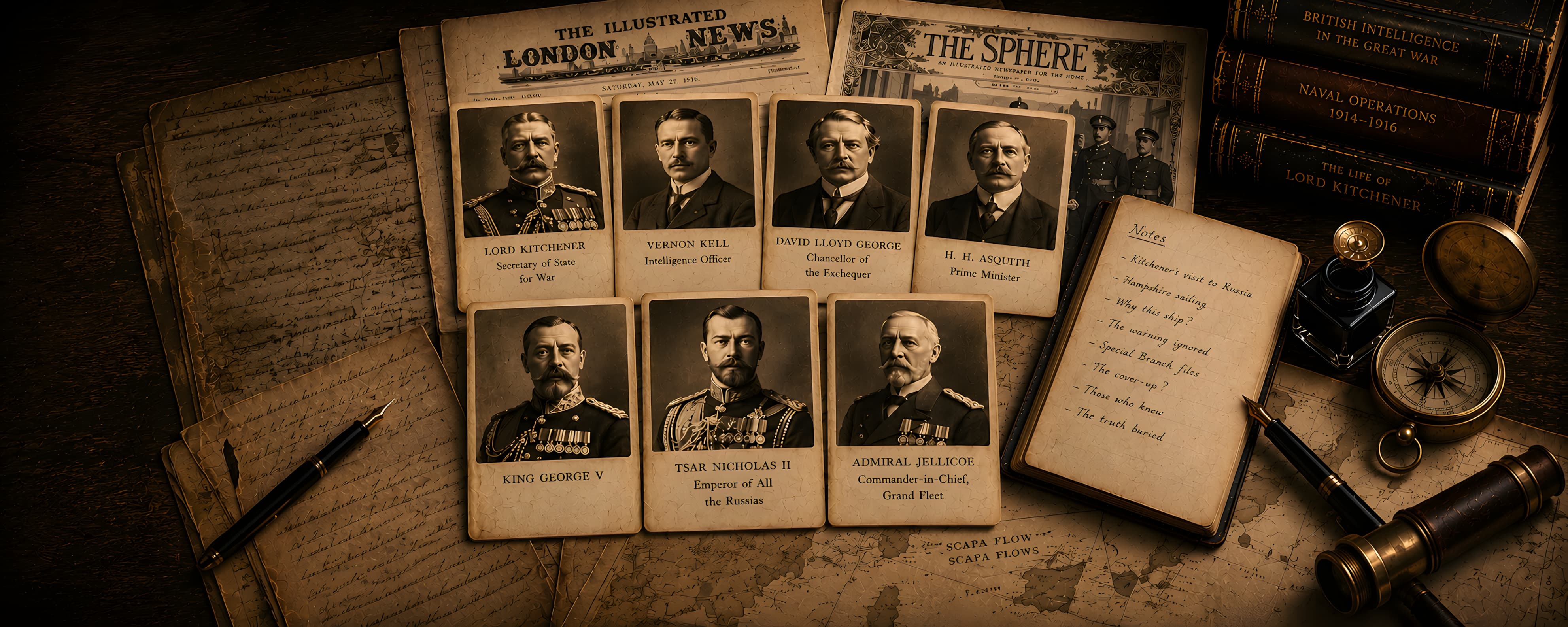

History's Cast
One of the more unusual aspects of Blackest of Lies is that almost everyone the reader meets actually existed. Cabinet ministers, naval officers, intelligence officials, politicians and members of the Royal Family all appear under their own names and perform the roles history records them as having undertaken.
Only one principal character, Lieutenant Christophe Hubert, is entirely fictional. A second, Anne Banfield, represents a real Special Branch officer whose existence is documented but whose name appears to have been lost when official records were destroyed during the Second World War. Beyond these two, the cast is overwhelmingly historical.
King George V (1865–1936)
King George V succeeded his father, King Edward VII, in 1910 and reigned throughout the First World War. Although a constitutional monarch with limited political power, he exercised considerable personal influence through his relationships with ministers and military leaders, particularly during times of national crisis.
When war broke out in August 1914, George recognised that Britain required a military leader who commanded the confidence of both the armed forces and the public. At his personal request, Field Marshal Lord Kitchener was appointed Secretary of State for War, despite having no previous political experience. The appointment proved one of the defining decisions of the early war years, with Kitchener overseeing the creation of the vast volunteer armies that would later fight on the Western Front.
George V was also closely connected to Europe's ruling families. He was the first cousin of Tsar Nicholas II of Russia and Kaiser Wilhelm II of Germany, a reminder that the First World War was fought between nations whose monarchs were, in many cases, close relatives.

In Blackest of Lies, King George's confidence in Kitchener and his support for Britain's wartime leadership form the political backdrop against which the story unfolds. Although he appears only briefly, his decisions helped set in motion the chain of events that ultimately led to Kitchener's ill-fated mission to Russia.
Tsar Nicholas II (1868–1918)
Tsar Nicholas II was the last Emperor of Russia, ruling the vast Russian Empire from 1894 until his abdication during the Russian Revolution of 1917. Although personally devoted to his family and deeply committed to his role, he struggled to govern a nation increasingly divided by political unrest, economic hardship and the immense pressures of modern war.
By 1916, Russia had suffered enormous losses on the Eastern Front. While its armies remained vast, chronic shortages of weapons, equipment and supplies, compounded by poor administration and corruption, seriously undermined morale. Nicholas recognised that maintaining Russia's commitment to the Allied cause was essential if Germany was to remain engaged on two fronts. Hoping to strengthen military cooperation and restore confidence within his senior command, he invited Lord Kitchener to Russia for high-level discussions.
Nicholas II was also closely related to many of Europe's monarchs, including King George V, who was his first cousin. Despite these family ties, the First World War placed them on opposite sides of an international crisis that would ultimately destroy several of Europe's great dynasties.
In Blackest of Lies, Tsar Nicholas's request for Kitchener's visit provides the catalyst for the novel's central events. Had that invitation never been made, Kitchener would almost certainly never have embarked upon the journey that ended with the loss of HMS Hampshire off the coast of Orkney.H. H. Asquith (1852–1928)
Herbert Henry Asquith served as Prime Minister of the United Kingdom
from 1908 until December 1916, guiding Britain through the opening years
of the First World War.
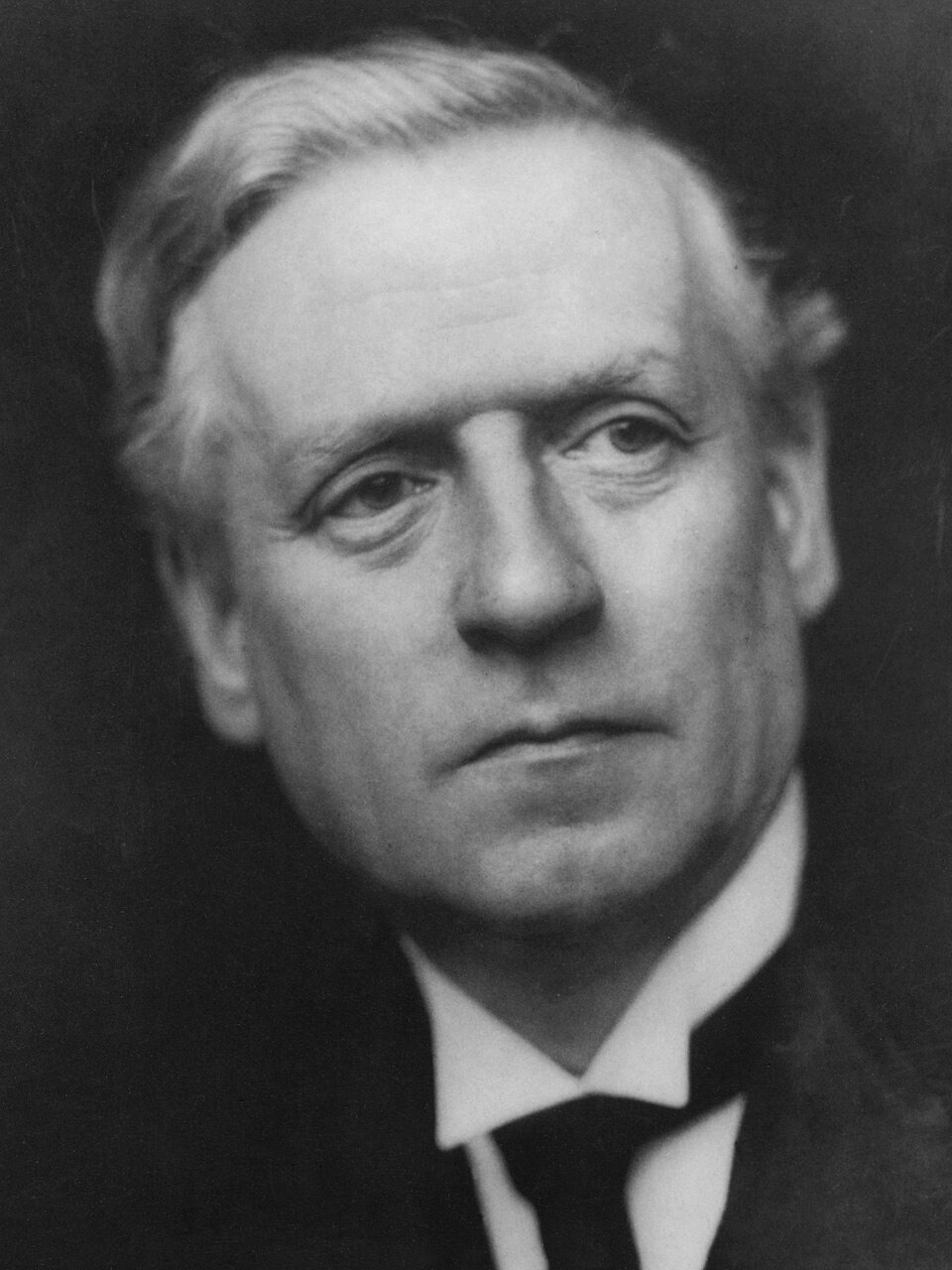
When war broke out in August 1914, Asquith recognised the need for a figure who could unite the nation and inspire confidence in the Army. At the personal request of King George V, he appointed Field Marshal Lord Kitchener as Secretary of State for War, despite Kitchener having no previous political experience. The decision proved pivotal. Kitchener's foresight in recognising that the conflict would be long and costly, together with his successful appeal for volunteers, helped transform Britain's military preparedness during the early years of the war.
By the summer of 1916, Asquith's government faced mounting military, political and economic pressures. Nevertheless, it approved Kitchener's hazardous diplomatic mission to Russia, believing that maintaining Russia's commitment to the Allied cause was of vital strategic importance. The loss of HMS Hampshire and Kitchener's death deprived Asquith of one of the nation's most respected military leaders and dealt a severe blow to public morale.
In Blackest of Lies, Asquith represents the political leadership under whose authority the novel's events unfold. His decisions, together with those of King George V and Tsar Nicholas II, form the chain of events that ultimately led to Kitchener's final voyage.
Field Marshal Lord Kitchener (1850–1916)
Few soldiers have ever become as instantly recognisable as Herbert
Horatio Kitchener.
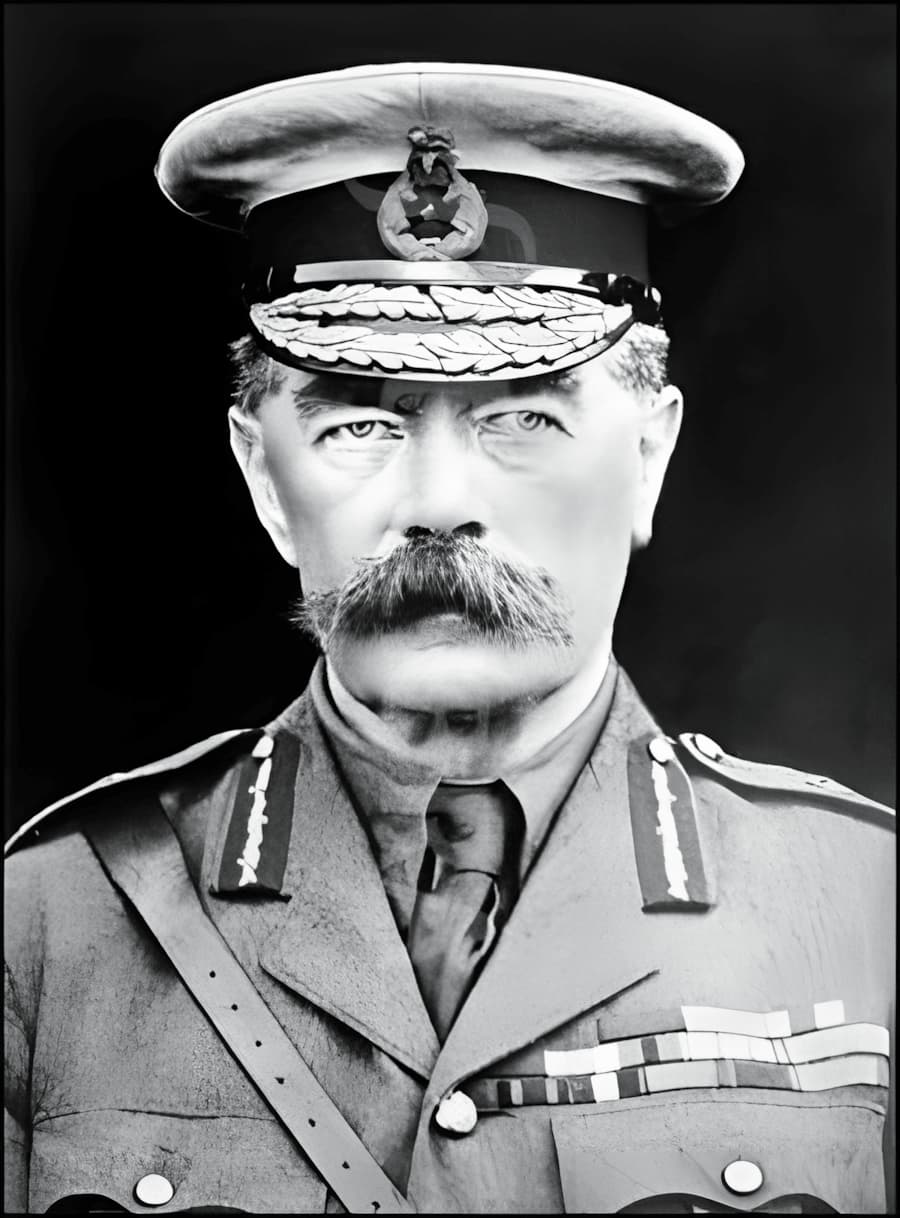
Although not a politician, Kitchener was appointed Secretary of State for War in August 1914 at the personal request of King George V. He immediately recognised what many others failed to appreciate — that the war would not be over within a few months, but would become a long and costly struggle. Under his leadership Britain began raising the vast volunteer armies that would eventually fight on the Western Front, while Alfred Leete's famous "Your Country Needs You" poster transformed him into a national icon.
Reserved, disciplined and often difficult to know personally, Kitchener inspired both admiration and criticism. His determination, independence and unwillingness to compromise sometimes brought him into conflict with politicians and fellow commanders, yet his judgement on the likely length and scale of the war proved remarkably accurate.
In June 1916, at the request of Tsar Nicholas II, Kitchener undertook a diplomatic mission to Russia in an effort to strengthen Allied cooperation. On 5 June, while travelling aboard HMS Hampshire, his ship struck a German mine off the coast of Orkney and sank with heavy loss of life. Kitchener's body was never recovered, and the circumstances surrounding his death gave rise to speculation and conspiracy theories that continue to this day.
In Blackest of Lies, Kitchener is far more than a historical backdrop. His final journey, and the mysteries that followed it, form the very heart of the story.
Lieutenant-Colonel Oswald Arthur Gerald FitzGerald (1873–1916)
Lieutenant-Colonel Oswald FitzGerald served as Lord Kitchener's Personal
Secretary during the First World War and was among the handful of
men who knew the Field Marshal best.

Although rarely in the public eye, FitzGerald occupied a position of considerable trust. His close working relationship with Kitchener meant that he accompanied him on important journeys and attended many of the meetings at which wartime policy was discussed. Those who knew him regarded him as devoted to his chief, combining administrative skill with a quiet professionalism that perfectly complemented Kitchener's reserved nature.
When Lord Kitchener embarked on his diplomatic mission to Russia in June 1916, FitzGerald travelled with him aboard HMS Hampshire. Witnesses later recalled seeing the two men together during the ship's final moments after she struck a German mine off the Orkney coast. FitzGerald was killed in the sinking, but unlike Lord Kitchener, his body was recovered from the sea. He was accorded a full military funeral at Eastbourne, attended by representatives of the King and Britain's allies, before being laid to rest beside his father.
The funeral of Lieutenant-Colonel Oswald FitzGerald was captured on film and survives today. The footage provides a remarkable glimpse into the national mourning that followed the loss of HMS Hampshire and Lord Kitchener's party in June 1916.
Contemporary newsreel footage of Lieutenant-Colonel Oswald FitzGerald's funeral.
In Blackest of Lies, FitzGerald's close proximity to Lord Kitchener places him at the centre of the events surrounding the Field Marshal's final journey. As Kitchener's most trusted aide, he represents both the loyalty and the human cost of one of the First World War's most enduring mysteries.
Captain Vernon George Waldegrave Kell (1873–1942)
Captain Vernon Kell was the founding Director of Britain's Security
Service and the man who created what would later become known simply
as MI5.
Unlike many of his contemporaries, Kell combined military experience with exceptional linguistic ability. Educated in both Britain and Germany, he spoke several European languages fluently and possessed a deep understanding of the cultures and military thinking of Britain's potential adversaries. Quiet, analytical and intensely private, he preferred careful investigation to dramatic action, believing that good intelligence depended upon patience, discretion and meticulous attention to detail.
During the First World War, Kell transformed MI5 from a handful of officers into a nationwide counter-espionage organisation responsible for identifying enemy agents, protecting vital industries and safeguarding Britain's war effort against sabotage. Working closely with the police, the armed services and allied intelligence organisations, he established many of the principles that continue to underpin British security operations today.

In Blackest of Lies, Kell serves as both mentor and employer to Lieutenant Christophe Hubert and Inspector Anne Banfield. While demanding absolute loyalty from those who work for him, he possesses an unusual willingness to judge individuals by their ability rather than by their background or social standing. It is this quality that enables him to recognise potential in both the young Canadian officer recovering from his wounds and the determined Special Branch detective whose superiors have come to regard her as an inconvenience.
Although seldom occupying the centre of events, Kell's quiet influence is felt throughout the novel. Calm where others become emotional, and deliberate where others rush to judgement, he represents the measured professionalism upon which Britain's intelligence services were built.
Kell did not leave a biography behind, very probably due to the extreme sensitivity of his role. His wfe, however - Lady Constance - wrote her own memoirs of her husband's service. For memny years, the manuscript remained in the family until, in 2017, it was decided to publish it, in accordance with her wish that some day it might be read by others.
It can be purchased on Amazon in hardback, paperback and eBook formats here.
Colonel Charles à Court Repington (1858–1925)
Colonel Charles à Court Repington was one of Britain's most influential military correspondents during the First World War. A former Army officer, he combined professional military knowledge with exceptional journalistic access, becoming defence correspondent for The Times. His reports were read not only by the public but also by politicians, diplomats and senior military commanders.

Repington's relationship with Lord Kitchener was deeply strained. He became closely associated with the controversy surrounding the shortage of artillery shells during 1915, publishing reports that embarrassed the Government and contributed to the political crisis that led to the creation of the Ministry of Munitions under David Lloyd George. Kitchener regarded Repington as indiscreet and eventually barred him from the Western Front, believing that his reporting endangered military operations and undermined confidence in Britain's leadership.
Although frequently controversial, Repington remained one of the most knowledgeable military journalists of his generation. His reporting helped shape public understanding of the war and demonstrated the growing influence of the press upon military and political affairs.
In Blackest of Lies, Repington represents the increasingly uneasy relationship between government secrecy, military necessity and a determined press eager to uncover the truth.
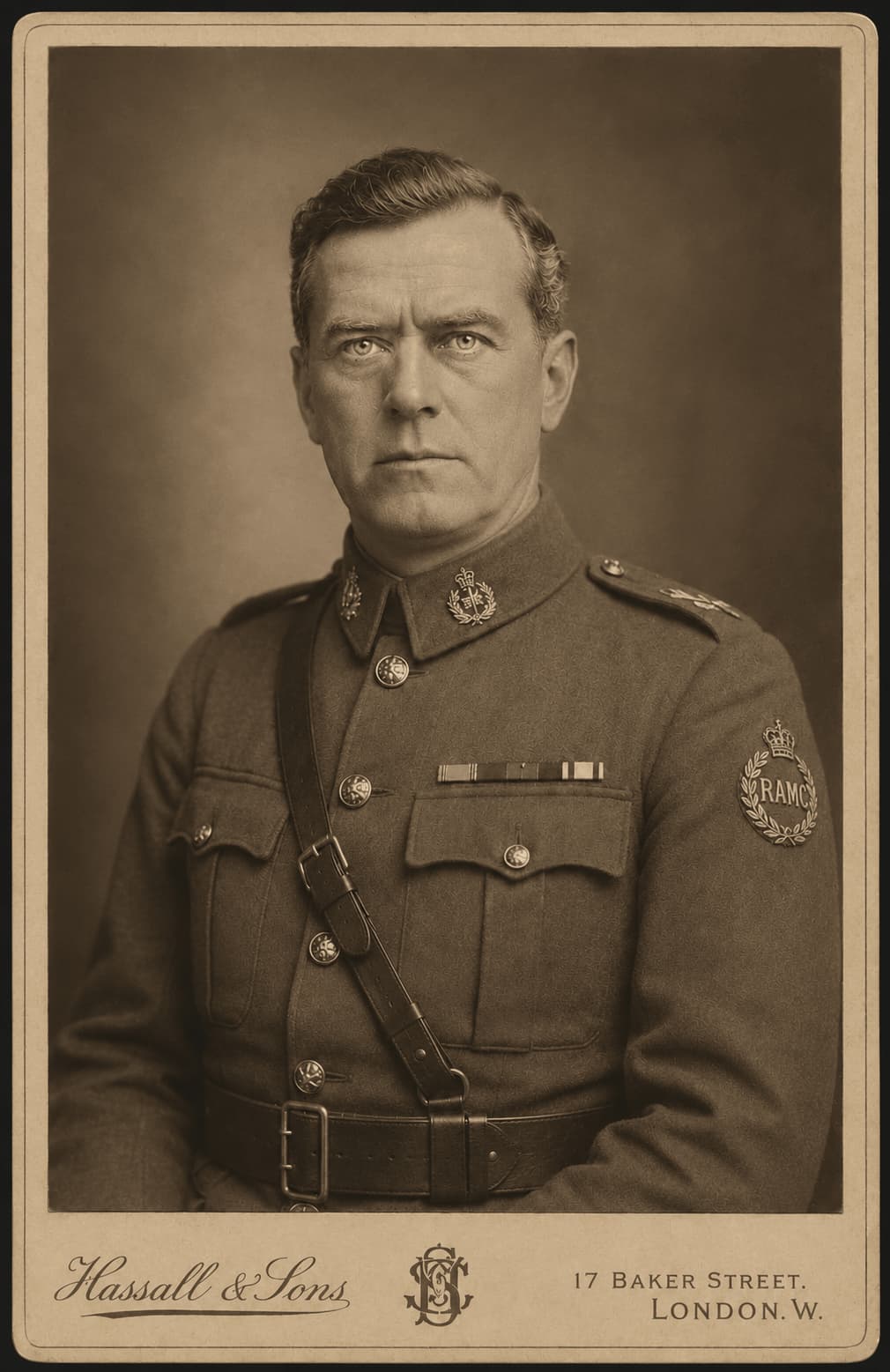
Lieutenant-Colonel Henry Farmer, RAMC (Fictional)
Lieutenant-Colonel Henry Farmer is one of only two wholly fictional principal characters in Blackest of Lies. Although he never existed, his career reflects that of many medical officers who served throughout the British Empire during the late Victorian and Edwardian periods.
After qualifying in medicine at Guy's Hospital, London, Farmer accepted
a commission in the Royal Army Medical Corps, serving for many years
with the British Army in India.
AI-Generated
Farmer possesses one particularly unusual habit. Closely resembling Lord Kitchener in height and build, he delights in wearing an extravagant imitation of the Field Marshal's famous moustache while making his hospital rounds. Accompanied by a passable imitation of Kitchener's deep, measured voice, the performance invariably raises the spirits of patients facing long recoveries and uncertain futures. Behind the humour, however, lies a deeply compassionate doctor who understands that recovery often depends as much upon hope as upon medicine.
Following the outbreak of the First World War, Farmer served with the Mediterranean Expeditionary Force during the Gallipoli Campaign. There he earned a Mention in Despatches for repeatedly treating wounded Australian and New Zealand troops under heavy enemy fire, refusing to leave the wounded despite sustained shelling and rifle fire. Like many RAMC officers, he regarded his duty as extending no further than the next casualty, regardless of the danger to himself.
Following the evacuation from Gallipoli, Farmer returned to Britain and was posted to the Royal Victoria Hospital at Netley, where he cared for soldiers recovering from wounds and the effects of poison gas. It was there that he first met Lieutenant Christophe Hubert, whose lungs had been permanently damaged by chlorine gas during the Second Battle of Ypres.
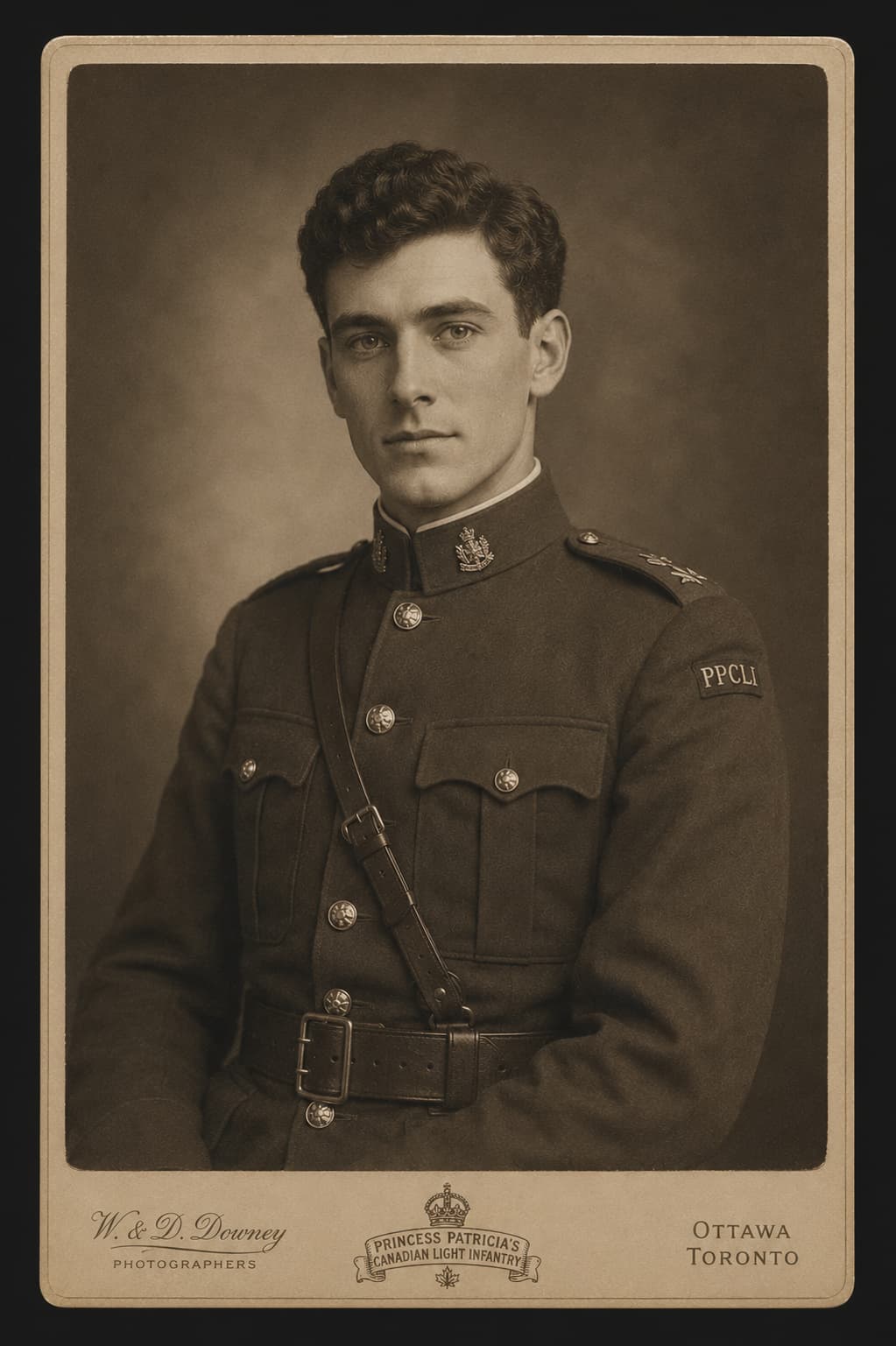
Lieutenant Christophe Hubert, MC, PPCLI (Fictional)
Lieutenant Christophe Hubert is one of only two wholly fictional
principal characters in Blackest of Lies. Born in Ottawa to French-Canadian
parents, he was raised in the family hotel business, dividing his
early years between Ottawa and Toronto.
AI-Generated
When war broke out in Europe in 1914, Hubert ignored his father's objections and volunteered for the Princess Patricia's Canadian Light Infantry, one of Canada's first infantry regiments to serve overseas. Possessing an instinct for reconnaissance and an appetite for calculated risk, he gained a reputation for leading small-scale trench raids into the German lines. His objective was seldom to inflict casualties. Instead, he preferred to capture prisoners who might provide valuable intelligence. Referring to these expeditions with characteristic understatement, Hubert described them as "bringing home a few guests for tea and questions." For his courage and leadership, he was awarded the Military Cross.
His active service came to an abrupt end during the Second Battle of Ypres in April 1915, when the Germans launched the first large-scale chlorine gas attack on the Western Front. During the fighting, Hubert's dugout collapsed beneath intense shellfire, burying him upside down beneath the earth. Rescue parties discovered only his boots protruding from the collapsed trench and succeeded in digging him free before he suffocated. Ironically, the soil that trapped him also shielded him from the full concentration of the chlorine cloud, saving his life while leaving him with permanent damage to his lungs.
After initial treatment at the Casualty Clearing Station at Poperinghe, he was evacuated to the Royal Victoria Hospital at Netley. Recovery proved slow, painful and deeply frustrating for a young officer determined to return to his regiment. There he met Lieutenant-Colonel Henry Farmer of the Royal Army Medical Corps, whose kindness, humour and encouragement became instrumental in his recovery.
Recognising that Hubert's physical injuries would probably prevent further front-line service, but aware that his linguistic ability, intelligence and proven courage remained valuable assets, influential figures within the Canadian High Commission arranged his secondment to MI5 rather than his discharge from the Army. It was the beginning of a very different war.
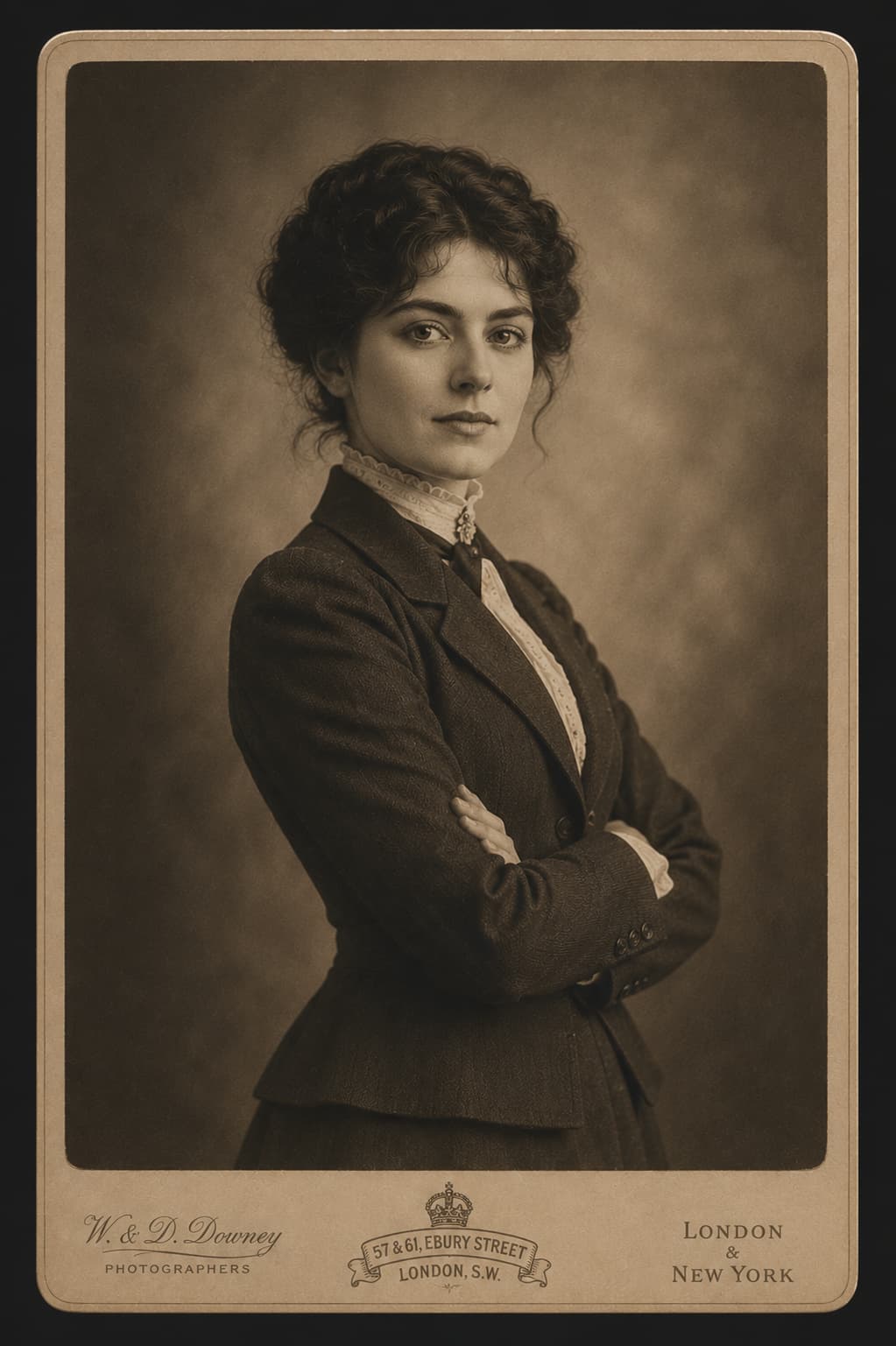
Inspector Anne Banfield (Partly Fictional)
Inspector Anne Banfield is based upon a real Special Branch officer whose existence is documented, but whose identity has been lost to history. Official records identifying her were destroyed during the Second World War, leaving only scattered references to a determined young woman who believed she had uncovered a conspiracy surrounding Lord Kitchener's final journey.
In Blackest of Lies, the name "Anne Banfield" has been given to
this otherwise anonymous officer. Intelligent, resourceful and fearless,
she is an experienced undercover operative whose investigations
frequently take her into places where conventional policing cannot
reach.
AI-Generated
Although outwardly presented as a routine transfer between departments, Banfield's subsequent attachment to MI5 is, in reality, a convenient way of removing an increasingly troublesome officer from Special Branch. There she forms an unlikely but highly effective partnership with Lieutenant Christophe Hubert.
Long before the events of Blackest of Lies, Banfield had already demonstrated an exceptional talent for counter-espionage. Although little can be said without revealing later developments in the series, it is strongly hinted that, during the closing months of 1913, she played a quiet but decisive role in frustrating a German intelligence operation aimed at undermining Britain's financial stability on the eve of war. Like so much of successful intelligence work, her greatest achievements remained unknown outside the small circle of those who understood their significance.
One historical mystery remained impossible to ignore. The real Special Branch officer is known to have died in Portugal during the 1950s as Madame Hubert, the widow of a Swiss hotelier. Christophe Hubert himself is entirely fictional, but this extraordinary coincidence became the seed from which one of the novel's central relationships grew. It is one of several occasions where the story follows history until history itself falls silent.
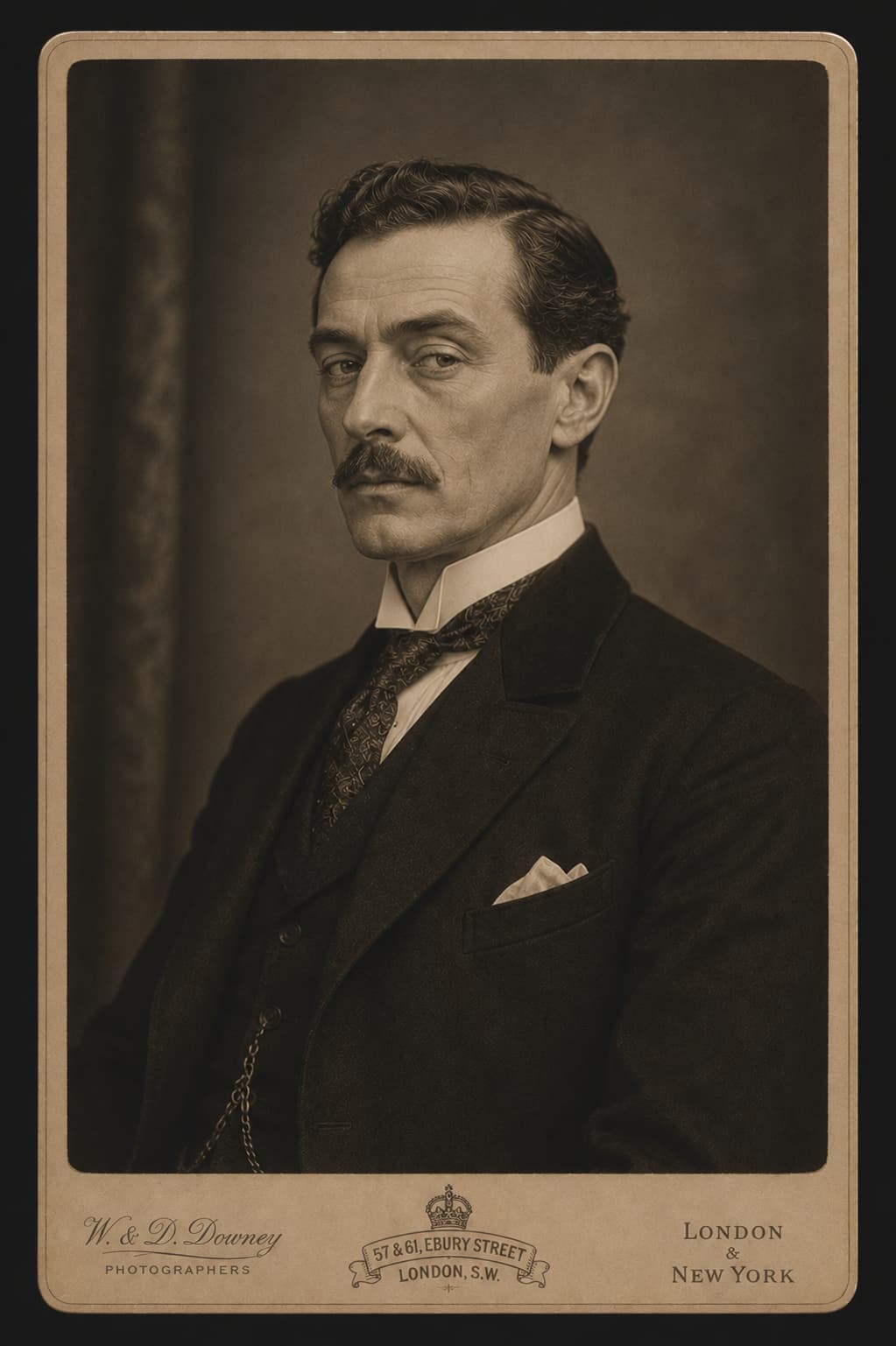
Boissier (Partly Fictional)
The historical record confirms that a man named Boissier was present on the Orkney island of Hoy following the loss of HMS Hampshire. Contemporary accounts collected by Harold T. Wilkins and later by Richard Hough and Richard Deacon, together with the controversial investigations of Donald McCormick, identify Boissier and a colleague named Pickup as being involved in preventing local islanders from assisting survivors coming ashore. Their true identities and official duties, however, remain uncertain.
AI-Generated
In Blackest of Lies, Boissier is imagined as Reginald Boissier, an MI5 field officer whose career began under a cloud. Formerly an Army officer, he was cashiered from the service in 1912 for reasons never publicly disclosed. Possessing courage, intelligence and a willingness to undertake work that more principled men might refuse, he was quietly recruited into the fledgling Security Service, where his talents proved more valuable than his reputation.
By 1916 Boissier had become one of MI5's trusted "fixers", accustomed to operating in the shadows where official rules became inconvenient. Resourceful, ruthless and fiercely ambitious, he measures success not by honour but by results. His loyalty is genuine, but it is first and foremost loyalty to himself and to his own advancement.
Before the events surrounding Lord Kitchener's final voyage, Boissier played a significant part in the counter-espionage operation centred upon London's Threadneedle Street, where his actions left Anne Banfield to face the consequences of decisions he was unwilling to share. Their mutual distrust continues throughout Blackest of Lies, where Boissier frequently pursues objectives that only partially coincide with those of his fellow intelligence officers.
Although often appearing to be little more than an antagonist, Boissier remains a far more complex character than first impressions suggest. As the series progresses, readers discover that even a man accustomed to deception and moral compromise is capable of unexpected courage and redemption.
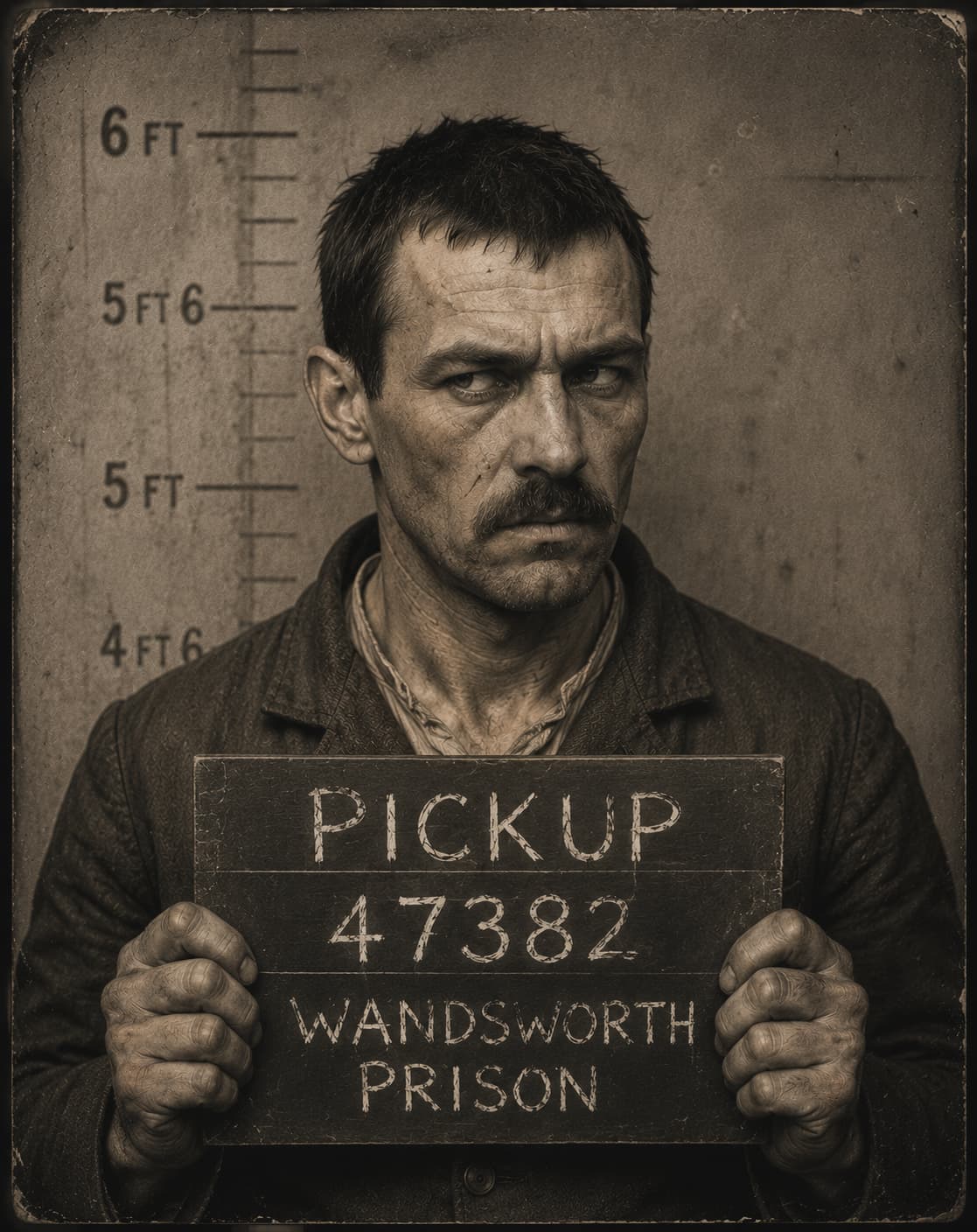
Pickup (Partly Fictional)
Like Boissier, Pickup appears fleetingly in several accounts connected with the aftermath of the loss of HMS Hampshire. Contemporary witnesses place him on the island of Hoy, where he was alleged to have assisted in preventing local islanders from reaching sailors struggling ashore. Beyond his surname, however, almost nothing can be stated with certainty about his identity or official role.
AI-Generated
Blackest of Lies offers one possible explanation.
Before the outbreak of the First World War, Pickup had earned an unenviable reputation within London's criminal underworld as a gifted safe-breaker and burglar. Equally adept at opening locks, defeating alarms and disappearing without trace, he possessed precisely the skills that appealed to Britain's fledgling intelligence service. At the outbreak of war, MI5 quietly secured his early release from prison in return for undertaking work that demanded both criminal expertise and complete deniability.
Unlike many of those around him, Pickup possesses no sense of patriotism, duty or honour. His loyalty extends only as far as his own survival and continued freedom. Violence is never his first choice, but neither does he hesitate to employ it when intimidation fails. To him, people are obstacles to be overcome rather than lives to be valued.
Within MI5 he occupies an uncomfortable position. Officially he does not exist. Unofficially he undertakes the sort of assignments that respectable officers cannot acknowledge. Boissier recognises his usefulness; others regard him as a dangerous liability whose methods sit uneasily alongside the ideals they believe they are defending.
His contempt for Inspector Anne Banfield is immediate and mutual. Where Anne is guided by principle, Pickup is guided solely by expediency. Their repeated encounters throughout Blackest of Lies reveal two individuals operating in the same hidden world but according to entirely different codes.
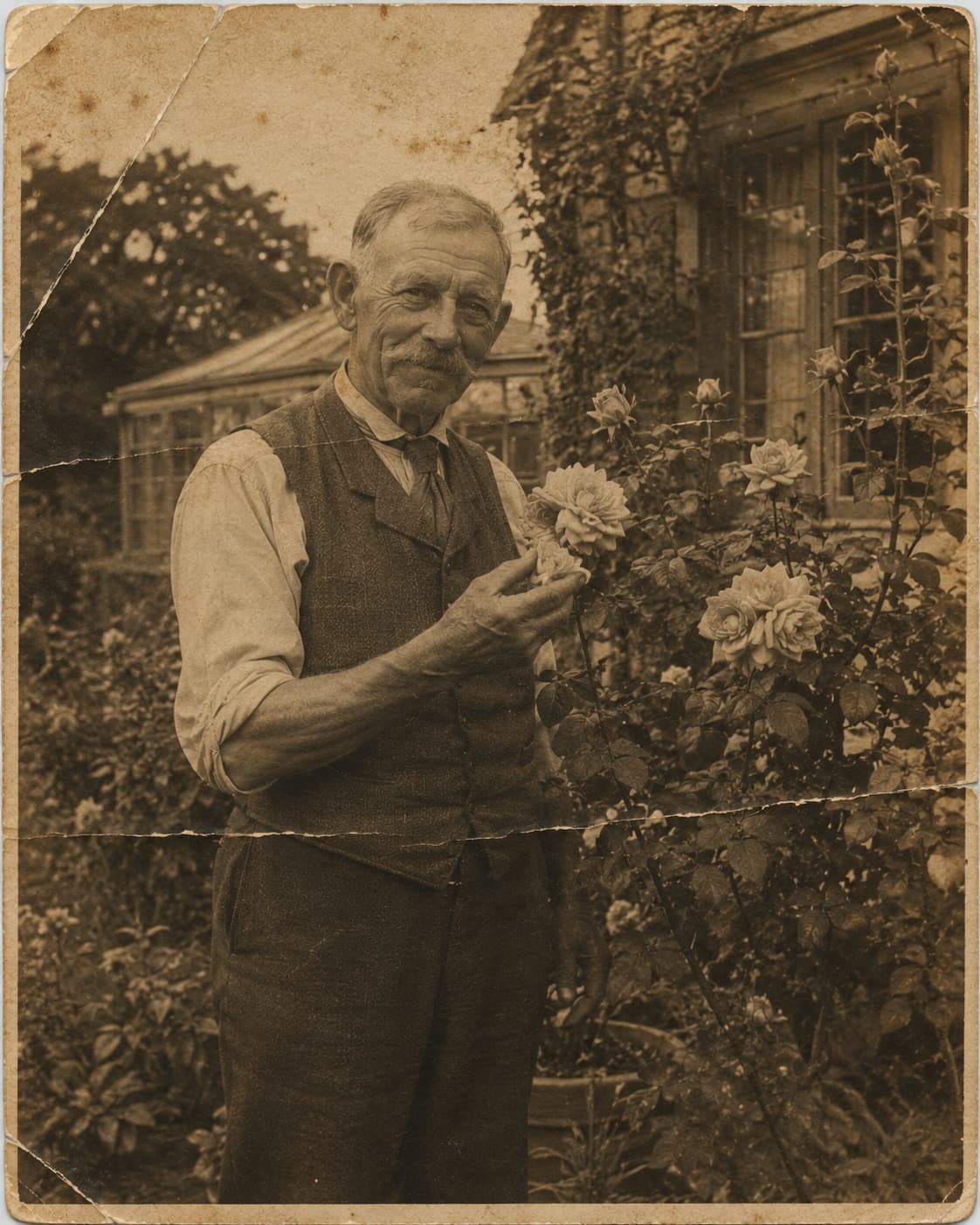
Thomas Dudeney
Thomas Dudeney served Lord Kitchener not as a soldier, but as head
gardener at Broome Park, the Field Marshal's country home in Kent.
By the time of Kitchener's final voyage in 1916, Dudeney was approaching
seventy years of age and had become one of the very few people with
whom Kitchener could truly relax.
AI-Generated
In Blackest of Lies, Dudeney's friendship with Kitchener has much deeper roots. As a young man, Dudeney enlisted in the 1st Battalion, The Lincolnshire Regiment, serving under Kitchener during the reconquest of the Sudan. He saw action at both Atbara and Omdurman, earning no decorations but gaining something he valued far more — the respect of the demanding commander who would later become Britain's most famous soldier. When Dudeney eventually left the Army to return to civilian life, the two men remained in occasional contact.
Years later, when Kitchener acquired Broome Park, he invited his former soldier to become head gardener. There, amid the rose gardens they both loved, their relationship evolved into one of mutual respect and genuine friendship. Dudeney became one of the few people prepared to speak to Kitchener without fear or deference, and one of the even fewer whose advice Kitchener would sometimes accept.
Although possessing little formal education, Dudeney's understanding of people frequently surpassed that of those in far grander positions. His warmth, humility and quiet wisdom provide a deliberate contrast to the world of politicians, diplomats and intelligence officers that dominates the novel.
Sir Basil Thomson, KCB (1861–1939)
Sir Basil Thomson was one of Britain's foremost police and intelligence
officials during the First World War.
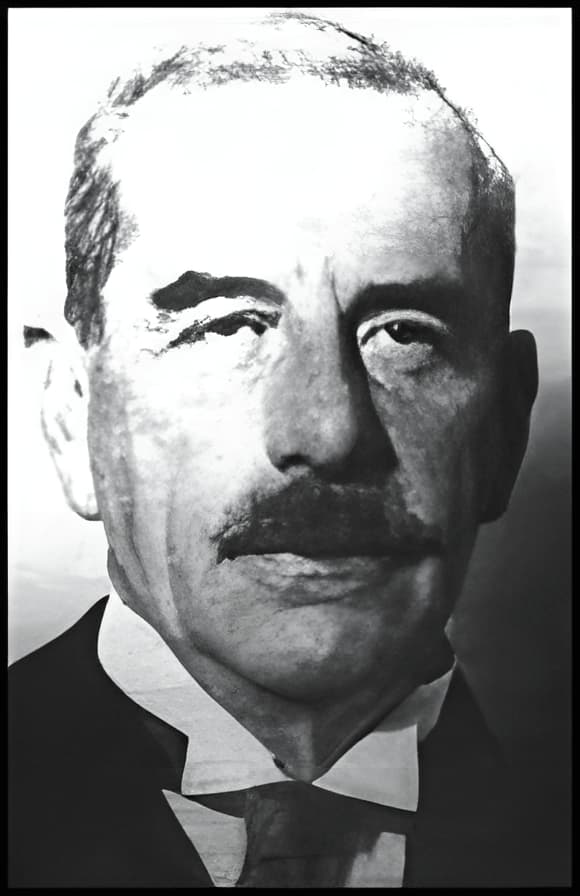
Intelligent, decisive and politically astute, Thomson possessed an exceptional understanding of revolutionary movements, espionage and internal security. He worked closely with Captain Vernon Kell's Security Service, although the responsibilities of MI5 and Special Branch frequently overlapped, occasionally leading to rivalry as well as cooperation.
Thomson believed that intelligence work demanded difficult choices. Throughout his career he demonstrated a willingness to place the perceived interests of the State above those of individual officers, an approach that earned him both admiration and criticism. He regarded discretion as an essential weapon and believed that some truths, however uncomfortable, were better left undisclosed if they threatened national stability or public confidence.
In Blackest of Lies, Thomson's determination to protect official secrets places him in direct conflict with Inspector Anne Banfield. Convinced that her investigation into Lord Kitchener's final mission risks undermining wider national interests, he engineers her transfer from Special Branch to MI5, believing the matter thereby closed. It is a decision that sets in motion many of the events that follow.
History has not judged Sir Basil Thomson simply. A gifted administrator and one of the architects of Britain's wartime security apparatus, his later career was overshadowed by controversy and public scandal. Yet his contribution to the development of British intelligence and policing remains substantial. Whether his actions concerning Lord Kitchener reflected prudent statecraft or a grave error of judgement is one of the questions explored in Blackest of Lies.
Admiral Sir John Jellicoe (1859–1935)
Admiral Sir John Rushworth Jellicoe commanded Britain's Grand
Fleet during the First World War and bore perhaps the greatest
responsibility of any Allied commander.
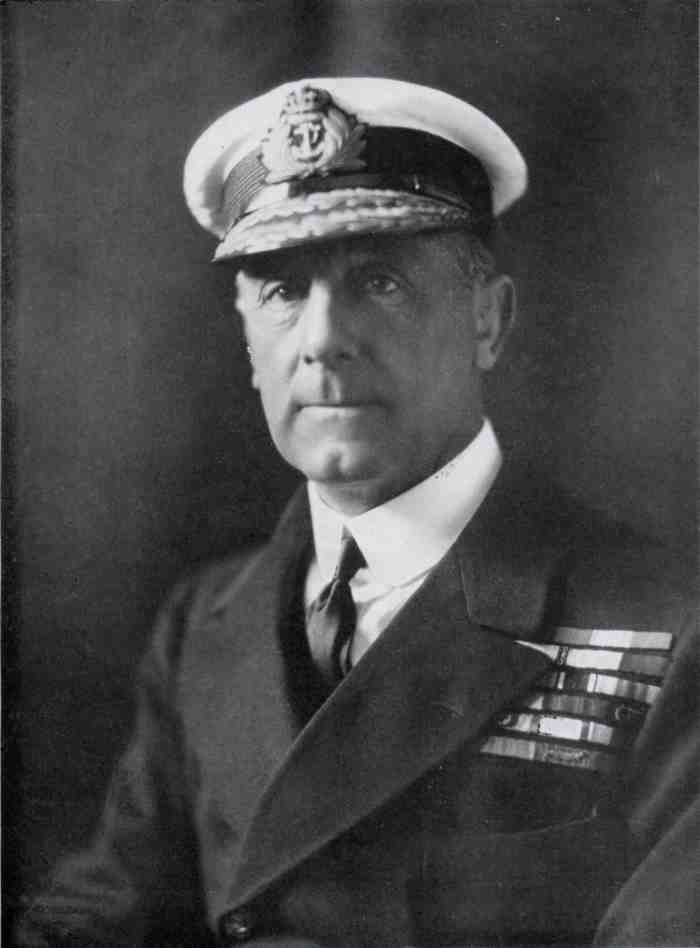
A highly experienced and respected officer, Jellicoe had served with distinction in Egypt, China and the Mediterranean before becoming Commander-in-Chief of the Grand Fleet in 1914. Methodical, cautious and intensely professional, he understood that Britain's greatest strategic asset was not victory in a single battle, but the continued existence of the fleet itself. As Winston Churchill later observed, Jellicoe was "the only man on either side who could lose the war in an afternoon."
It was aboard Jellicoe's flagship, HMS Iron Duke, lying at Scapa Flow, that Lord Kitchener and his party were received before transferring to HMS Hampshire for the onward voyage to Russia. Concerned by the deteriorating weather, Jellicoe advised postponing the departure, but Kitchener was determined to continue. When the worsening sea conditions forced Hampshire's escorting destroyers to turn back, the cruiser was left to continue her passage alone. Shortly afterwards she struck a German mine and was lost with devastating loss of life.
In Blackest of Lies, Jellicoe is portrayed as a conscientious naval commander faced with an impossible burden of responsibility. The tragedy of HMS Hampshire unfolds within his command, yet the circumstances surrounding the disaster raise questions extending far beyond naval operations alone.>
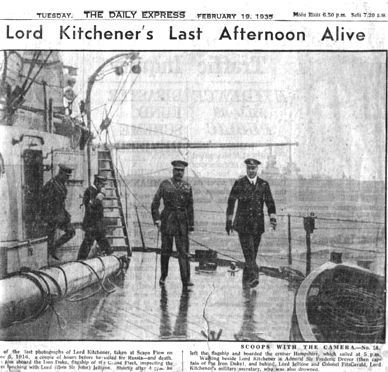
Although history has often remembered Jellicoe chiefly for the Battle of Jutland, modern scholarship has been kinder to his reputation. His careful stewardship of the Grand Fleet preserved Britain's command of the sea throughout the war, ensuring that Germany remained blockaded and ultimately unable to challenge Allied control of the oceans.
Captain Fritz Joubert Duquesne (1877–1956)

Few First World War spies acquired a reputation as extraordinary as Fritz Joubert Duquesne. Born in South Africa, Duquesne fought against the British during the Second Boer War and developed a lifelong hatred of the British Empire following the deaths of members of his family during the conflict. Charismatic, multilingual and a consummate adventurer, he became one of Germany's most celebrated intelligence agents during both World Wars.
Throughout his life, Duquesne claimed responsibility for a remarkable
catalogue of exploits, many of which have proved impossible to verify.
Among his most famous assertions was that he had personally orchestrated
the destruction of HMS Hampshire and the death of Lord Kitchener
in June 1916.
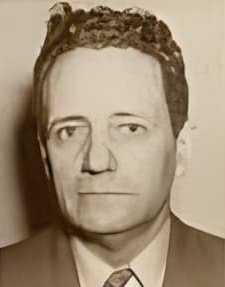
Nevertheless, Duquesne was unquestionably a skilled and dangerous intelligence operative. He conducted espionage, sabotage and deception on Germany's behalf for decades, repeatedly evading capture through disguises, false identities and sheer audacity. During the Second World War he became the leader of the infamous Duquesne Spy Ring in the United States before being arrested by the FBI in 1941.
In Blackest of Lies, Duquesne occupies the uncertain ground between history and legend. His reputation, his boasts and the myths surrounding his career all form part of the atmosphere in which the investigation unfolds. Whether he was truly involved in Lord Kitchener's fate — or merely claimed credit for events beyond his control — is one of the many questions the novel invites readers to consider.
Sean Gallagher (Historically Uncertain)
Sean Gallagher occupies one of the more uncertain corners of the
historical record surrounding Lord Kitchener's final voyage. His
name appears in Donald McCormick's controversial account of the
events leading to the loss of HMS Hampshire, where Gallagher is
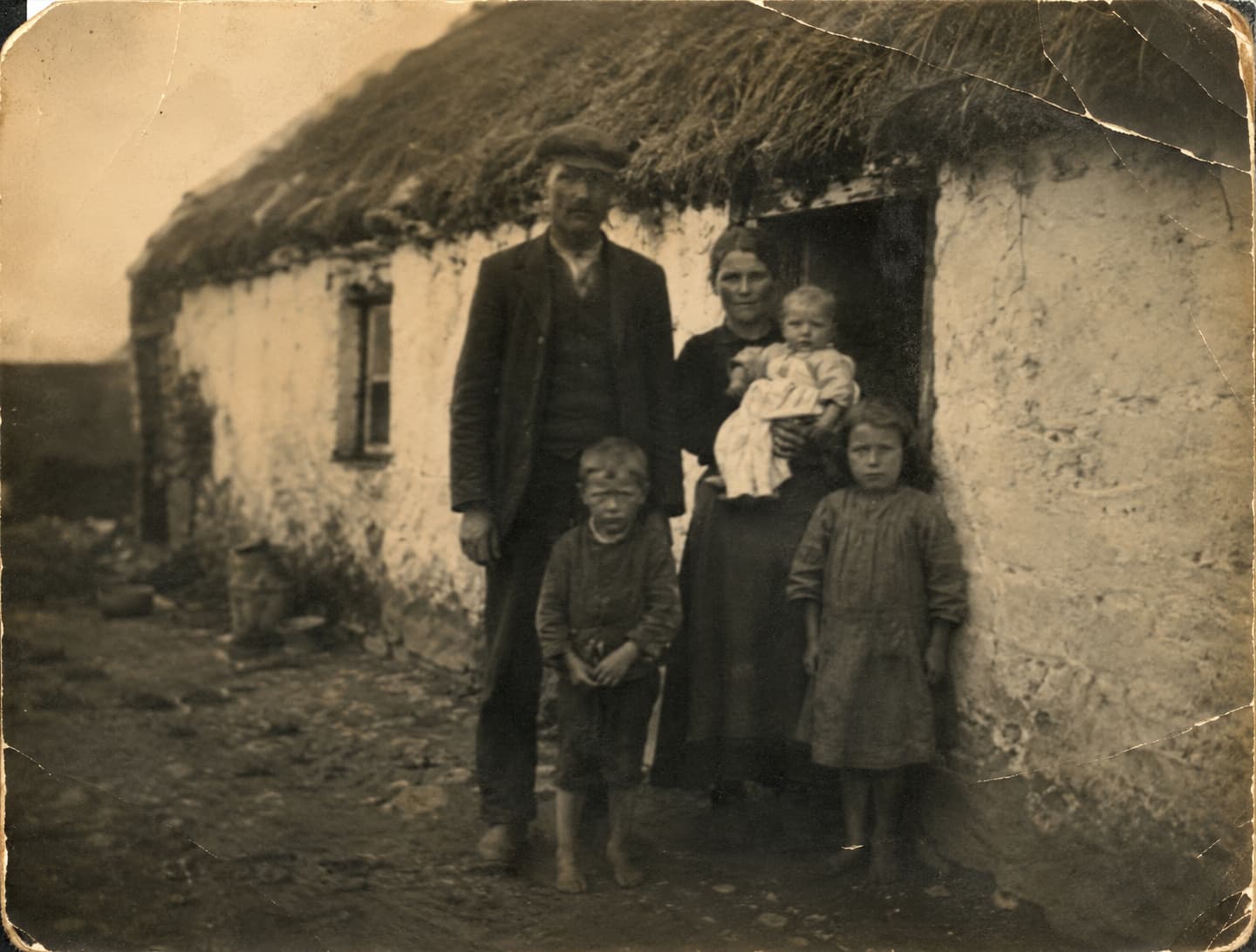
described as an operative of the Irish Republican Brotherhood allegedly
involved in a conspiracy against the Field Marshal.
AI-Generated
Whether Gallagher was a genuine individual operating under his own name, an alias adopted by another agent, or a figure whose existence cannot now be verified remains unknown. Like many aspects of the Hampshire story, the surviving evidence is fragmentary, contradictory and open to interpretation.
In Blackest of Lies, Gallagher is presented as a plausible interpretation of McCormick's account. A committed member of the Irish Republican Brotherhood, he is an experienced clandestine operative whose objectives are shaped entirely by his desire to secure Irish independence. Although prepared to cooperate with Imperial Germany when their interests temporarily coincide, his loyalty is never to Berlin but always to Ireland.
Unlike many fictional villains, Gallagher is driven not by greed or cruelty but by conviction. He sincerely believes that Britain's difficulties present Ireland with a unique opportunity to achieve freedom, and he is prepared to employ methods that others would regard as indefensible in pursuit of that goal.
Whether Sean Gallagher was a real man or merely one of the many shadows surrounding the HMS Hampshire disaster is a question that history has yet to answer. The novel does not claim to resolve that mystery; instead, it explores one possible explanation of how such a man might have fitted into the extraordinary events of June 1916.
Leutnant zur See Kurt Beitzen
Leutnant Kurt Beitzen was a submarine commander in the Imperial
German Navy during the First World War. Commanding SM U-75, he was
responsible for laying the minefield off the western coast of Orkney
in late May 1916.
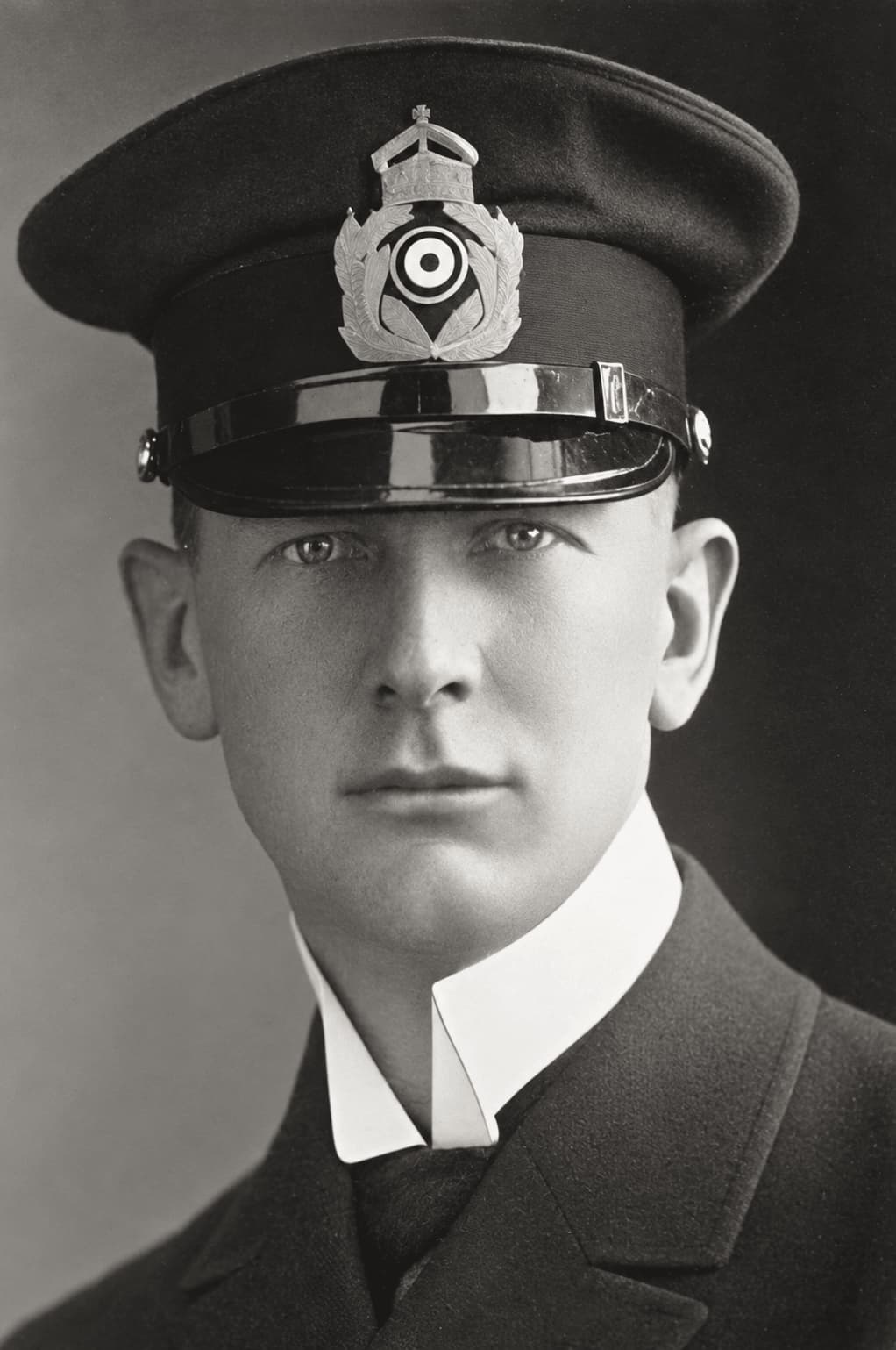
Unlike many figures associated with Lord Kitchener's death, Beitzen is firmly established in the historical record. His patrol orders, movements and mine-laying operations are well documented within German naval records and form the basis of the accepted explanation for the loss of the cruiser.
In Blackest of Lies, Beitzen is portrayed as a disciplined and highly capable naval officer rather than as a conventional antagonist. Like many professional sailors on both sides of the conflict, he regarded mine warfare as a legitimate military weapon.
The novel deliberately explores the distinction between historical fact and subsequent speculation. While Beitzen undoubtedly laid the mines that destroyed Hampshire, whether that alone explains every aspect of Lord Kitchener's final mission is a question left for the reader to consider.
A quiet professional rather than a committed ideologue, Beitzen serves as a reminder that many of those caught up in the events surrounding Kitchener's death were simply soldiers and sailors carrying out their duty as they understood it.
Beitzen did not survive the First World War. Like so many of the men whose lives briefly intersected with Lord Kitchener's final journey, he too became one of the conflict's casualties. His death serves as a reminder that the Great War consumed professional soldiers and sailors on every side, often leaving little more than a name in the historical record.
Gustav Steinhauer (c.1870–1930)
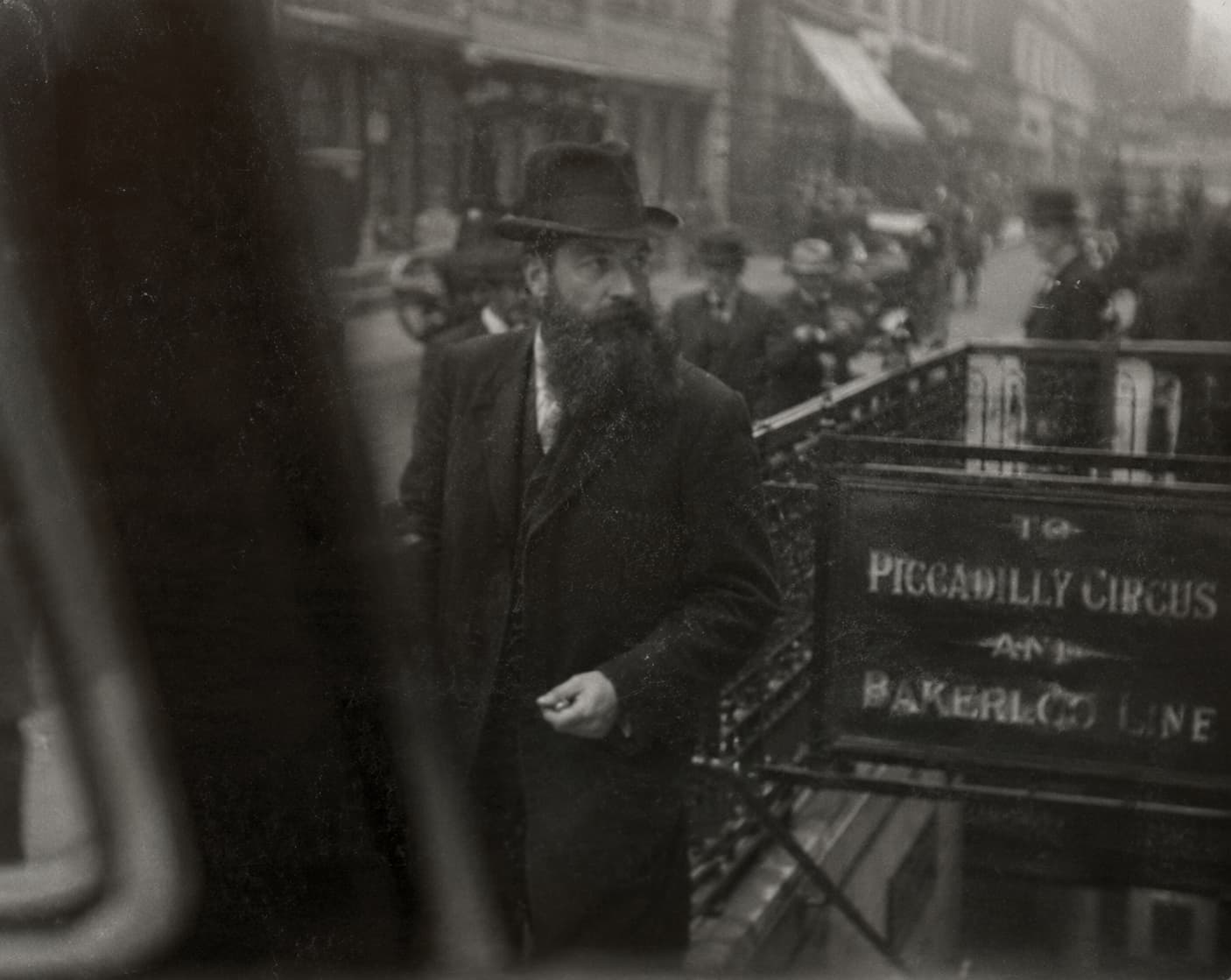
Gustav Steinhauer was one of Imperial Germany's most accomplished
intelligence officers and, before the outbreak of the First World
War, headed the British section of the German Admiralty's intelligence
service, the Nachrichten-Abteilung.
AI-Generated
Long before Britain created the modern Security Service, Steinhauer had begun constructing an extensive network of German informants throughout the United Kingdom. Rather than relying upon professional spies, he recruited businessmen, commercial travellers and other civilians with access to ports, dockyards and naval installations. His methods were patient, methodical and remarkably successful until Captain Vernon Kell's fledgling MI5 began intercepting his correspondence and systematically identifying many of his agents.
Steinhauer was no ordinary intelligence officer. In 1901, while serving as part of Kaiser Wilhelm II's security detail during Queen Victoria's funeral, he worked alongside the British detective William Melville to prevent an assassination attempt against the Kaiser. The episode demonstrated a curious reality of pre-war Europe: intelligence officers who would later become bitter enemies were, only a few years earlier, cooperating in the protection of visiting heads of state.
In Blackest of Lies, Steinhauer represents the strategic mind directing Germany's intelligence operations against Britain. He is portrayed not as a theatrical villain, but as a thoughtful and highly professional opponent whose greatest weapon is patience. His contest with Kell is one of intellect rather than violence, each recognising in the other a worthy adversary.
Unlike many of the shadowy figures surrounding the loss of HMS Hampshire, Steinhauer's place in the history of international espionage is firmly established. His memoirs, published after the war under the title "Steinhauer: The Kaiser's Master Spy", provide a fascinating, if naturally self-serving, account of the secret intelligence struggle that preceded and accompanied the First World War.
Further Reading
"Full list of Hampshire's lost published today" - The Orcadian Online, The Orcadian - Hampshire List .
HMS Hampshire 100 - University of Dundee, HMS Hampshire 2016 Expedition .
Herbert Kitchener, 1st Earl Kitchener, Wikipedia article on Lord Kitchener .
Biography of Kitchener, Harold Begbie's Biography of Lord Kitchener .
HMS Hampshire (1903), Wikipedia article on HMS Hampshire .