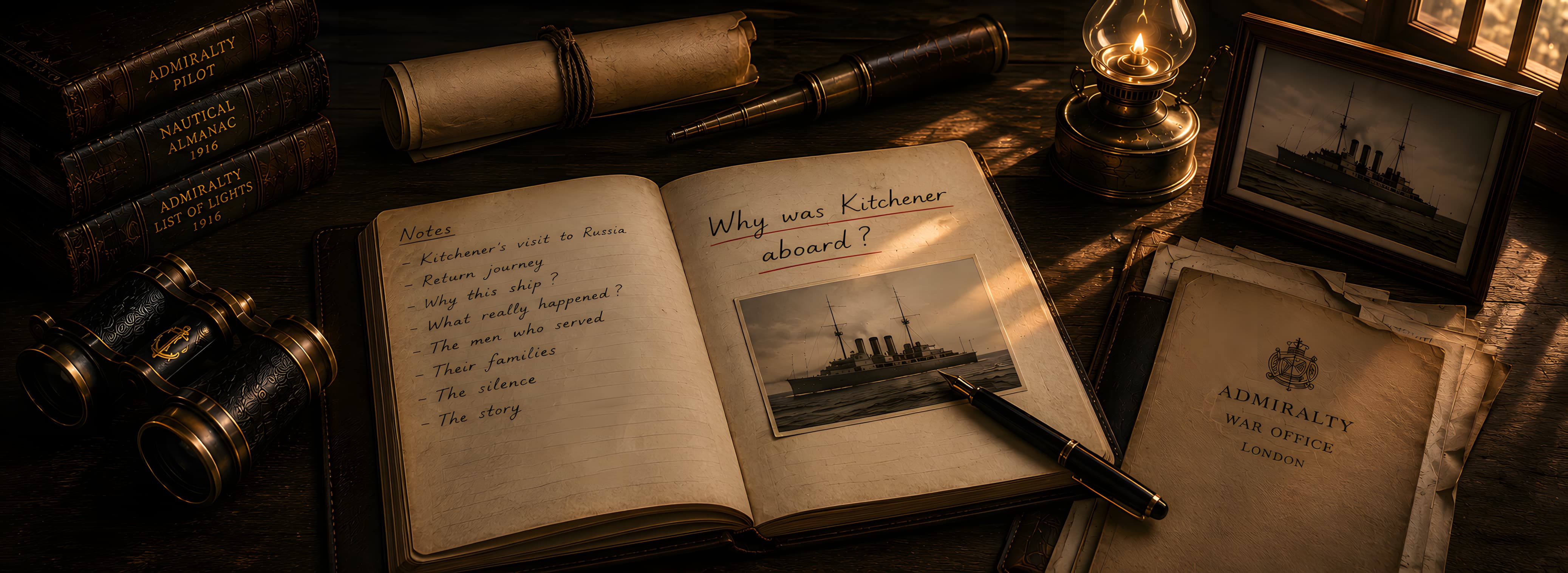

The Concept
Every novel has a beginning. Mine did not begin with a character, a battle or even a plot. It began with a book discovered quite by chance in a military library.
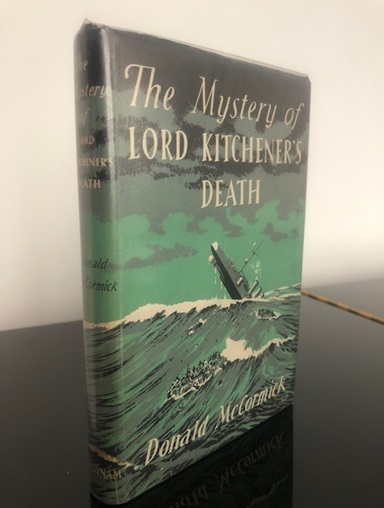
Donald McCormick (Richard Deacon)
During my service with NATO in Norway, I made a weekly pilgrimage to the station library. On one such visit I came across The Mystery of Lord Kitchener's Death by Donald McCormick, better known to many readers by his pseudonym, Richard Deacon.
McCormick's investigation explored one of Britain's enduring historical mysteries – the loss of Lord Kitchener aboard HMS Hampshire in 1916. His conclusions were controversial, relying heavily upon personal testimony and sources that could not always be independently verified. I accepted many of his theories with a healthy degree of scepticism. On the Historical Facts page, we examine which aspects of his account are supported by documentary evidence, which remain matters of debate, and where Blackest of Lies deliberately parts company with history in the interests of fiction.
Yet that was never the point.
Whatever the truth behind the events, the story itself was astonishing. I remember closing the book with a single thought:
"Whether this happened or not, it would make a wonderful work of fiction."
That moment planted the seed which would eventually grow into Blackest of Lies. At the time, however, the project bore a very different working title: Double Jeopardy.
Finding the Right Title
As the novel evolved, it became increasingly clear that its original title no longer captured its central theme. The story is not simply about deception. It is about the dangerous power of truths woven together with falsehoods, until the distinction between the two becomes almost impossible to detect.
The answer came from Alfred, Lord Tennyson's poem The Grandmother, containing the memorable observation that,
"a lie which is half a truth is ever the blackest of lies."
That single phrase perfectly expressed the heart of the novel. Outright lies can often be challenged. Lies built upon fragments of truth are infinitely more dangerous because every genuine fact lends credibility to the deception surrounding it.
Intelligence work has always occupied that uncertain ground. Rarely does an intelligence officer possess the complete picture. Decisions must often be made from fragments of evidence, eyewitness accounts, intercepted communications and rumours, each containing its own measure of truth and falsehood. The real challenge lies not in recognising an obvious lie, but in distinguishing genuine fact from carefully crafted deception.
That ambiguity lies at the heart of Blackest of Lies. It is not simply a story of espionage or conspiracy, but of people attempting to discover the truth when every answer appears plausible and every certainty is open to question.
Readers who would like to read Tennyson's complete poem can find it here: The Grandmother – Alfred, Lord Tennyson .
From Inspiration to Novel
The initial idea proved remarkably persistent. What began as a passing thought in a NATO library slowly developed into years of historical research, the examination of contemporary documents, and countless hours spent separating established fact from speculation.
My intention was never to write a history book. Historians are rightly concerned with what can be demonstrated. Novelists have a different privilege: to ask, "What if?" As long as the fiction respects the known historical record, imagination can explore possibilities where history must remain silent.
Blackest of Lies is the result of that journey. It is not a claim to reveal the truth behind one of Britain's great historical mysteries. Rather, it is an attempt to tell a compelling story inspired by the remarkable events, personalities and unanswered questions that surround it.
Historians naturally seek to establish what happened. Conspiracy writers often seek to prove what they believe happened. As a novelist, I was interested in something rather different. I wanted to explore what might have happened within the spaces that history cannot fill.
Further Reading
Donald McCormick (Richard Deacon),
The Mystery of Lord Kitchener's Death.
At the time of writing (4 July 2026), a copy was on sale on AbeBooks.
Alfred, Lord Tennyson, The Grandmother .